The key facts
- A semi-trailer carrying two cotton harvesters detached on a slope in Chirchiq and destroyed part of an elderly couple's house on September 10.
- Over a month later, the family has no official damage assessment and no information on who was held responsible; gas supply remains unrestored.
- The couple says trucks are banned on this street with a 12% slope warning, and questions how such oversized cargo was allowed there.
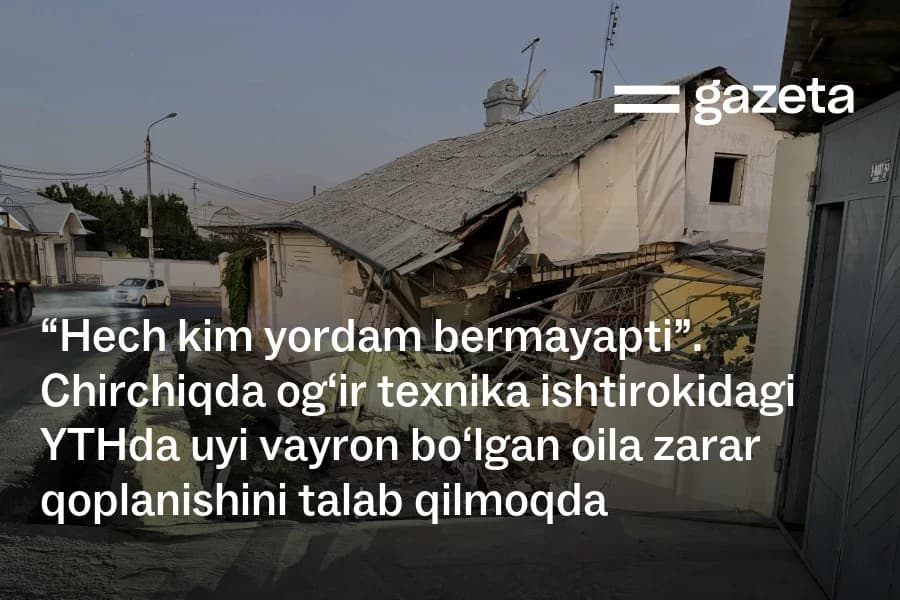
On September 10, on Sadriddin Ayniy street in the city of Chirchiq, Tashkent region, a semi-trailer loaded with combine harvesters detached from its truck and broke loose. It moved down the sloped road and crashed into the private home of the elderly couple Gulbi Turdiqulova and Abduvali Berdibekov. The semi-trailer destroyed a brick wall, part of the house walls and roof, and damaged the interior decor, property, and the gas pipeline.

Photo taken on the day of the incident by internal affairs officers.
Advertising on "Gazeta"
According to the Chirchiq city administration, the circumstances of the incident are being studied by the city's road traffic safety department. The Ministry of Internal Affairs said that city internal affairs bodies are conducting an investigation. More than a month has passed, yet the family has not received an official damage assessment and has no information about who was found responsible for the incident. Gas supply has not been restored, and the residents have begun repairing the house on their own.
"The trailer destroyed the living room"
Gulbi Turdiqulova and Abduvali Berdibekov moved in 1986 to house 5/1 on the narrow 8-March street in Chirchiq. Their children grew up here, and later the sons and daughters married and began living separately. Now only 72-year-old Gulbi Turdiqulova and 74-year-old Abduvali Berdibekov live in this home.
The house is located along a major road, at a bend and on a slope. The family considers this stretch of road dangerous. According to Gulbi Turdiqulova, trucks had previously lost control in this area and crashed into roadside barriers and neighbors' houses.
"As you can see, our street is very dangerous, with many bends. Cars have crashed into the walls of neighbors' houses several times and knocked down the protective barriers installed along the road. ZIL trucks have also run off the road and come within a hair's breadth of crashing into houses. We have told internal affairs officers about this many times, but they only came, looked, and left. I cannot recall any result. I regret that we did not film those incidents on video. Now we could prove that such events have happened here before," says Turdiqulova.
According to her, on September 10, at around 15:00, after finishing her prayers, she went to the market. Her husband stayed home. Abduvali Berdibekov usually rested during the day on the sofa in the living room. But that day he had first sat down to eat in the kitchen and then planned to go into the living room to lie down.

Gulbi Turdiqulova. Photo: Mirolim Isajonov / Gazeta.
"We are almost always in the living room. Luckily, I had gone to the market that day, and my husband had not yet lain down to rest. God protected us," says the woman.
At around 15:30, Abduvali Berdibekov heard a loud impact. He tried to open the door leading to the living room, but it would not open: the impact had shifted the house's structures, blocking the passage. When the man went outside through another door, he saw that a semi-trailer carrying two cotton harvesters had crashed into the house, destroying the brick wall and the protective barriers. According to the couple, there were two combines on the platform. One of them is visible in a photo taken after the incident.
Gulbi Turdiqulova was informed of the incident at around 16:00. When she returned from the market, the house was destroyed and the combines were standing in the yard.
Screenshot from video
"It was terrifying to see. Everyone was running in all directions, doing something, employees from various organizations had arrived. But I was in shock — I did not understand who had come or what documents were drawn up. It was a huge blow for me and my husband. My blood pressure spiked, and the medical workers who came gave me an injection. My husband's blood pressure was also higher than usual," she says.
Employees of organizations such as internal affairs, road traffic safety, emergency situations, and gas supply, as well as doctors, arrived at the scene.
How did the incident happen?
According to the family's assumption, the truck pulling the trailer was moving up Sadriddin Ayniy street. At the bend, the truck collided with a passenger car. The impact damaged the trailer's coupling mechanism, and it began moving backward down the sloped road.

Abduvali Berdibekov. Photo: Mirolim Isajonov / Gazeta.
"The semi-trailer was very long — about 20 meters. Together with the two combines, its weight, by my estimate, was 50–60 tons. I later learned that as the truck was turning, a passenger car came toward it. There was a collision, the driver turned right, and the trailer's hitch could not withstand it. The trailer broke loose and went backward down the slope. It first hit our neighbor Tohir's house, then went over the bordyur, broke the protective barriers, and crashed into our house," says Berdibekov.
The couple did not witness the incident themselves. They reconstructed the sequence of events based on witnesses' accounts. Official agencies have not yet confirmed that the trailer collided with a passenger car. The Ministry of Internal Affairs reported that the trailer detached due to technical reasons.
Gulbi Turdiqulova says truck traffic is banned on this route and also questions the procedure for transporting heavy and oversized cargo.
"Truck traffic is banned here, and there are warning signs that the road has a 12 percent slope. So such vehicles should not travel on this road. Moreover, this is oversized cargo. As I understand it, such transport should be escorted, and the route should be checked in advance," says the woman.

Semi-trailer loaded with combines. Photo taken on the day of the incident by the affected family.
Clearing up the aftermath of the incident took several hours. First one combine, then the second was removed from the trailer. Because the first crane's capacity was insufficient to lift the semi-trailer, additional equipment was called in. According to Abduvali Berdibekov, the work of removing the machinery from the area continued until midnight.
"After the machinery was fully removed, representatives of the administration, the gas service, and the police gathered in front of our house. They said they would meet here again the next day at 10:00 to discuss how to solve the problem. The next day we waited for them, but no one came," he says.
Only after the machinery was removed from the yard could the couple fully see the damage done to the house. The impact caused part of the guest room's outer wall to collapse, the ceiling and roof were damaged, and the windows were broken. The furniture and household appliances in the room were also damaged. The semi-trailer passing along the wall of the adobe house also damaged the gas pipe and meter. According to the family, there has been no gas in the house since September 10.
Who do the combines belong to?
The combines being transported through Chirchiq were intended for the Tashkent Tractor Plant LLC, a manufacturer of state-owned agricultural machinery. Since March 21, 2021, the enterprise has operated under the AgroTech Klaster brand. It was established as part of the creation of an agricultural machinery cluster in Chirchiq. The plant produces tractors, grain harvesters and cotton-picking combines.
The company's general director Ulugbek Matkarimov told Gazeta that the transportation of the combines was not organized by the plant. According to him, choosing the transport company, hiring the driver and delivering the machinery to the plant's territory were the responsibility of the Chinese company Xinjiang Boshiran Intelligent Agricultural Machinery.
The state of the house after the semi-trailer carrying the combines was removed."Under the contract, the Chinese company was supposed to deliver the combines to our plant's territory. They also hired the drivers and the transport. The truck does not belong to us, and the driver was not an employee of our enterprise. We are the party receiving the machinery, while the supplier is responsible for delivery," says Matkarimov.
According to information the company provided to the editorial office, a contract was signed with Xinjiang Boshiran Intelligent Agricultural Machinery on June 9, 2026. It stipulated the CIP — Chirchiq term under the Incoterms-2020 rules. Under it, the Chinese company was required to choose the carrier, conclude a contract with it, and pay the transport costs and insurance.
Matkarimov said that since the plant did not conclude a contract with the logistics company, he did not know its name. The editorial office was also not given information about who owns the truck and semi-trailer, or in which organization the driver worked. It was not possible to contact the driver.
The company also submitted a report drawn up on September 12. The document was formalized with the participation of representatives of the plant, the neighborhood (mahalla), the city administration and internal affairs bodies. It states that the combines were transported by the logistics company engaged by Xinjiang Boshiran, and that it must fully compensate for the damage caused.
The Chinese supplier, in a letter sent to the plant, expressed readiness to eliminate the consequences of the incident at its own expense. However, the document was mainly devoted to the damage to the combine, its diagnostics and repair. It did not indicate the names of the owners of the damaged house, the amount of compensation and the deadlines for its payment, nor the procedure for receiving the compensation.
Why couldn't the family and the plant agree on repairs?
The day after the incident, the general director of AgroTech Klaster and his deputy met with the homeowners.
According to Gulbi Turdiqulova, they promised to help with repairing the house. However, the woman first asked to inspect the house, assess the damage caused, and define the company's obligations in writing.
"I looked at the house and said that simply patching it up would not settle the matter. I asked one of the representatives: 'Would you live in a house like this yourself?' After such an impact, the house needs to be inspected, the damaged part demolished and rebuilt. I offered two options: either they build us a smaller room in place of the destroyed one, or they call a commission, assess all the damage and pay money in that amount. Then we could do everything properly and restore it ourselves," says Turdiqulova.
According to Abduvali Berdibekov, the company's representatives only offered to "help as much as they could." However, they did not clarify exactly what work they were ready to perform and who would be responsible for the quality of the repairs. The family asked that the scope and deadlines of the restoration work be defined in writing.
"They said they would help as much as they could. But what does 'as much as they could' mean? We didn't know what materials they would bring, how well the work would be done, and exactly what they would restore. If they hurriedly lay a few bricks, raise the roof and leave, and then there's an earthquake or the ceiling collapses again, who will answer for that? That's why we asked for all the work to be carried out in accordance with the law. If they don't want to do the repairs, let them pay its value, and we will hire the craftsmen ourselves," says Abduvali Berdibekov.
According to the couple, the issue of monetary compensation was also raised during the conversation, but the company's representatives did not agree to give the family money. Gulbi Turdiqulova emphasized that the family was not against restoring the house. They wanted to know exactly the scope of the work to be done and to receive a guarantee that the house would be safe after the repairs.
The company's general director, however, interpreted the meeting differently. In his comment to Gazeta, Ulugbek Matkarimov said that since the transportation of the cargo was organized by another company, the plant had no legal obligation to restore the houses. Nevertheless, according to him, the company offered help "from a humanitarian point of view."
"We went to the homeowners and asked what kind of help they needed: repairs, legal advice or something else? Although this was not our obligation, we offered to restore the damaged parts. As I understand it, the elderly people agreed to this, but the young woman who was there said we should do nothing. She explained that the family has a lawyer and they will settle the matter with the logistics company. We also informed the bodies conducting the investigation about this," says Matkarimov.
To confirm its position, the company submitted a report drawn up on September 12 and signed by representatives of the plant, the neighborhood, the administration and internal affairs bodies. It states that the plant offered to help repair the damaged part of the house, but the homeowners' relative Jazira Baykuatova asked to postpone starting the work until she consulted with a lawyer. It also notes that she said she would contact the company again if necessary.
However, neither Jazira Baykuatova nor the homeowners signed the report. For this reason, the document reflects only the position of the parties that drew it up and does not confirm that the family definitively refused repairs or compensation.
According to the couple, on that day it was their son and daughter-in-law who spoke with the factory representatives. They conveyed the position of the affected family: the scope of work to be performed should be determined, and repairs should not begin until the safety of the house is ensured.
No results from the appeals so far
The family, unable to reach an agreement with the company's representatives on the procedure for restoring the house, turned to a lawyer. On September 15, applications were prepared on behalf of the homeowners to the Chirchiq city mayor's office, the city police department, and the prosecutor's office. When no concrete solution came, on September 23 the family wrote to the president's virtual reception office.
"Because we do not know all the laws and cannot visit various organizations ourselves, we were forced to hire a lawyer. We asked for only one thing: let everything be lawful. Let a commission come, inspect the house, calculate the damage, and say who must compensate it. We are not coveting anyone's property; we only want the destroyed things to be restored. But so far there has been no result at all," says Gulbi Turdiqulova.
The information service of the Chirchiq city mayor's office confirmed to Gazeta that the family's appeal had been received. The appeal was reviewed by the mayor's office's housing and utilities department. The city Road Traffic Safety Service is conducting an inquiry to determine the causes of the incident and give it a legal assessment.
However, the mayor's office did not clarify whether the interagency commission requested by the family had been formed. Nor was any information provided about whether the technical condition of the house's walls, roof, and other structures had been inspected.

According to the mayor's office, the amount of material damage and the procedure for its compensation must be determined by the authorized bodies after a legal assessment of the incident is given. However, the response did not indicate which organization exactly is supposed to carry out such an assessment.
"At present, the homeowners are repairing the part damaged as a result of the traffic accident. The roof covering has been fully replaced with profiled sheet metal, and construction and repair work is ongoing. If specialists determine that the condition of the structures poses a threat to citizens' safety, the authorized organizations will take the necessary measures," the mayor's office's response says.
The gas supply issue remains unresolved. The mayor's office confirmed that the house's gas infrastructure was damaged as a result of the accident. According to the administration, its restoration falls within the competence of the gas supply organization, and this work can be carried out after the technical condition of the network is inspected. No information was given about when specialists will conduct the inspection and when gas supply will be restored. According to the family, there has been no gas in the house since September 10.
According to information provided to Gazeta by Interior Ministry press secretary Shohrukh Giyosov, the Chirchiq city police department is conducting an inquiry into the incident under Article 133 of the Code of Administrative Liability. This article provides for liability for a driver's violation of traffic rules resulting in minor bodily injury or substantial material damage.
The ministry's statement also said that the damage caused to the house will be compensated in accordance with the procedure established by law. However, it did not explain who exactly must pay the compensation, how its amount will be determined, and what actions the victims should take.
"No one helped us"
The family, unable to wait for the damage to be assessed and repair work to begin, was forced to demolish and restore the destroyed parts of the house at their own expense. The homeowners dismantled the roof, and are now rebuilding the damaged wall. Afterwards, they covered the roof with profiled sheet metal.
"The rainy season is beginning, the weather is getting colder. My wife and I are the only ones left in this house. We could not wait any longer, so we started the repairs ourselves. We demolished the damaged parts of the house because leaving them in that condition was dangerous. No one helped us," says Abduvali Berdibekov.
According to Gulbi Turdiqulova, in the first days after the incident, among the officials who came, no one came to ask how the family was doing.
"More than a month has passed. Neither the local authorities, nor the mayor's office, nor the factory came to check on us. As if nothing had happened. We are not demanding much. The main thing is that our material and moral damage be compensated and that someone take responsibility for what happened," she says.
In the opinion of the family's neighbor Botirali Rahmonberdiyev, road traffic safety in this area needs to be strengthened, the speed of cars needs to be controlled, and the roadside barriers need to be reconsidered. According to him, local residents had previously reported several times to the responsible organizations that this road was dangerous.

The family has not yet calculated how much money has been spent on repairs. They emphasize that starting the repair work does not mean giving up their demand for compensation or for identifying those responsible for the incident.
So far, it is not known what the official conclusion on the technical condition of the house is, what the exact amount of the damage is, and on whom the obligation to pay compensation will be placed. However, the family continues to spend money on restoring their home.