The key facts
- The BBC published one of Anna Politkovskaya's last interviews, recorded in 2006 shortly before her death; the Russian original was released recently.
- Politkovskaya said Putin's policy was 'killing' the democracy just being born in Russia and that solving the problems he created would require great effort from future generations.
- She believed the 2004 elections were falsified despite widespread public support for Putin, and noted that under Putin no major private TV channels remained in Russia.
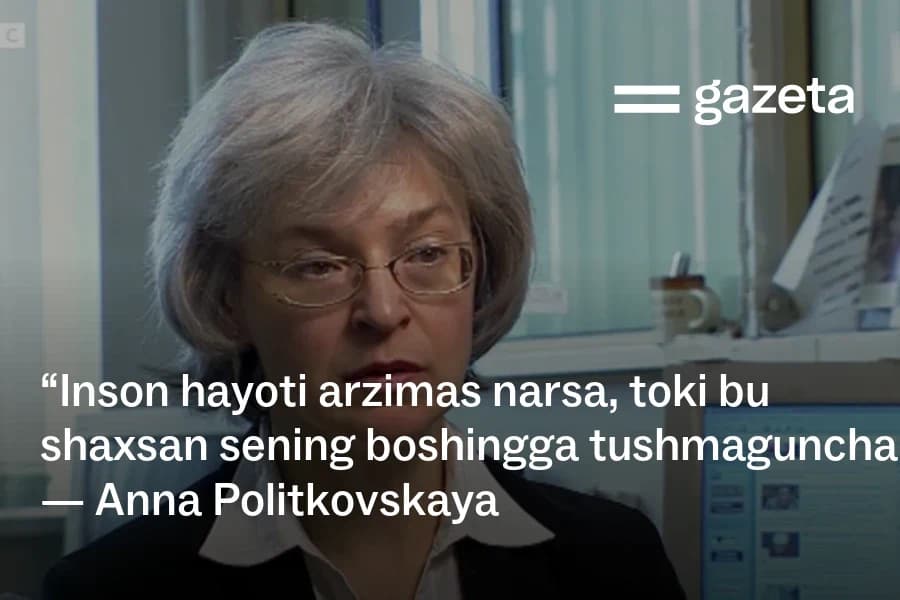
On October 7, the BBC published one of the last interviews of the prominent Russian journalist and human rights advocate, known for her investigations into cases of human rights abuses in Chechnya and her open criticism of the Russian government, who was assassinated on that date 20 years ago — Anna Politkovskaya's one of her last interviews was released. The interview was broadcast in English on BBC channels in November 2006, after Politkovskaya's death. Its original in Russian was released only recently. Gazeta presents the text of the BBC interview.
During her career as a journalist, Anna Politkovskaya first worked for the publications Izvestia and Obshchaya Gazeta. From 1999 until the end of her life she worked at Novaya Gazeta as a special correspondent and columnist. The Second Chechen War was the main subject of her investigations. The journalist visited the war zone several times and wrote about violence against civilians, torture, filtration camps and people who disappeared without a trace. In a word, she tried to make public the truth that official sources concealed. Through this, Politkovskaya became a symbol of independent journalism in Russia.
 Photo: Novaya Gazeta
Her work, of course, did not go unpunished: the journalist was detained, threatened with execution, and poisoned. On October 7, 2006, Politkovskaya was shot dead in the elevator of her apartment building in Moscow. Those who carried out the murder were tried and held accountable. Nevertheless, the person who ordered it has still not been officially identified.Advertising on Gazeta
In 2006 — some time before Politkovskaya's death, when this interview was recorded — it had been six years since Vladimir Putin came to power. The most intense phase of the war in Chechnya had passed, but the war was still ongoing. It was a time when, after the wave of apartment building bombings in 1999, the Nord-Ost and Beslan hostage-taking incidents, the explosions on passenger planes and in the metro, Russia continued to be shaken by terrorist attacks. At that time, two years still remained until the end of Putin's second term, and there was a perception that, according to the Constitution, this would be his final term.
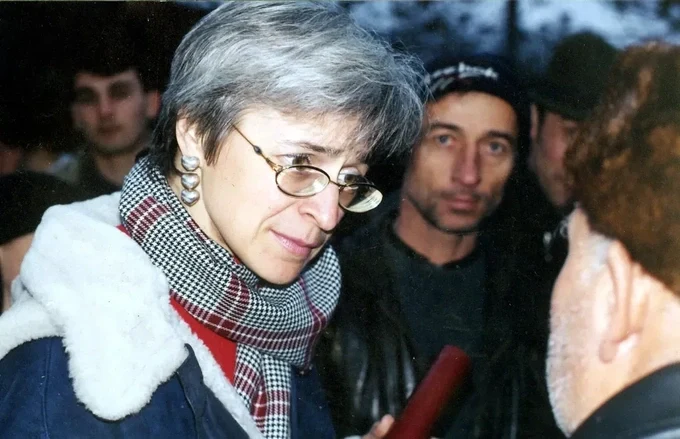 Photo: Novaya Gazeta
Assessing Putin's policies at that time, Politkovskaya emphasized that this policy was 'killing' the democracy that had only just begun to be born in the country, and that resolving the problems he had created would require great effort from future generations.
"Democracy was being born. But he is killing democracy. His years in the Kremlin are leading to a situation in which the next generation of our state's citizens will have to accomplish enormous work to free themselves from these problems. Here is the father of the family. What is he leaving to his children? If he is leaving this state of affairs, he is a bad father. If he leaves behind solid moral foundations and a good basis for the family's material support, he is a good man. Right now there is nothing that can be considered positive," says Politkovskaya.
She says that despite the fact that many people in the country were well disposed toward Putin, she viewed the claim that the 2004 elections were not falsified with skepticism.
"The remnants of Stalinist thinking are still very strong in many people. Thinking like a great power, thinking like an empire. These people, of course, voted for Putin. But, in my view, the elections were falsified all the same," the journalist emphasizes.
In August 1999, the Second Chechen War began. From its very first days, Politkovskaya traveled to the North Caucasus. In the following years as well, she went to the war zone in Chechnya and wrote dozens of articles about the suffering civilians, the wounded, the refugees, and the war's echo beyond the republic. Chechens held her in deep respect for her open and impartial articles. According to the journalist in the interview, when Putin came to power, he did not want there to be peace in Chechnya.
 September 3, 2004. The assault on School No. 1 in the city of Beslan. Photo: Yuri Tutov / Kommersant
"Yeltsin, despite his terrible, sometimes very grave mistakes, at a certain stage did listen to the press, and the war ended with a peace treaty. True, problems then arose with the implementation of that treaty. I agree with that. But none of this can be compared with Putin's deeds. He started the Second Chechen War and from the very beginning declared that there would be no peace. No matter what anyone did, no matter what arguments were put forward, he relied only on force. On nothing else," she says.
In Politkovskaya's view, on the question of the war in Chechnya, the logic of Putin's decisions was based on bowing to no one and disregarding any sacrifice along the way. "The casualties among the ordinary population were not taken into account at all. It is with these principles that it is regarded as an absolutely legitimate war."
 1995, Grozny. Photo: Mikhail Evstafiev / AFP
According to the BBC, one of the first striking events of Putin's rule was the raid on NTV. The channel frequently criticized Putin's position on the Chechen war and his attitude toward the sinking of the Kursk submarine. The puppet theater shows aired on the channel on weekends parodied leading politicians.
"NTV was a private television channel. It was owned by the oligarch Vladimir Gusinsky. Just four days after Putin's first inauguration, the FSB, the prosecutor's office and tax officials stormed NTV's office. Journalists were summoned for questioning. Despite protests from journalists and the public, in 2001 NTV passed into the hands of the state company Gazprom. By the end of Putin's first term, no major private television channels remained in Russia," the BBC recounts.
According to Politkovskaya, having come to power without a political program, Putin destroyed the open and independent press that could have exposed him.
"He became president without any program. Without any promises. If there had been independent television, it would have torn Putin to shreds. That is clear as day," says Politkovskaya. "He took part in no debates, because he is incapable of it. He has no program for debating. His chauvinistic and imperialistic inclinations were exposed by the democratic and independent press. These are perhaps his own ideas, or those of his closest political advisers. He set about eliminating every obstacle and succeeded. The critics disappeared and the flatterers multiplied. Whatever he did was applauded. And television became what it was in the Soviet era."
By the middle of the Second Chechen War, Politkovskaya was not only a journalist but also a public figure, says the BBC. In October 2002, when the Dubrovka theater was taken hostage, Politkovskaya fearlessly entered the building. The Chechens demanded that she specifically take part in the negotiations. She brought water to the hostages and relayed the demands of those who had seized the theater. They had demanded that Putin promise to stop the war in Chechnya.
"We all thought this would be a turning point. That things could not continue this way. I believed that decisions would be made at the state level so that an event like this could never be repeated. But I was sorely mistaken. Because no state decision was made to prevent people from ending up in such a situation. On the contrary, as they would put it, a fight against terrorism was launched, and it applied entirely Stalinist rules — Stalinist repressions — especially to Ingushetia and Chechnya," she recalls.
In Politkovskaya's view, such a policy breeds terrorism. Helpless families whose loved ones had been abducted or killed had nowhere to turn to find their relatives or to seek justice against their executioners. As a result, small terrorist attacks and suicide bombings had already been occurring in Chechnya.
The Nord-Ost events, she notes, were the logical continuation of these events. The Nord-Ost events could — indeed, should — have "changed everyone's views, opened the eyes of even those lying in the mud." But that did not happen. According to Politkovskaya, the people's anger, which could have forced Putin to make decisions in the interests of the people and for public safety, never materialized.
"What is public safety? It is a policy aimed at eliminating terrorist attacks. There was no such policy. On the contrary, a tightening began. In Ingushetia, those seeking revenge for this policy only grew in number," the journalist emphasizes.
In Politkovskaya's view, the Beslan events were a direct continuation of Nord-Ost. The journalist explains this by the fact that the country's top leadership made no attempt to understand the causes of the terrorist attack, who these people were, and why they carried out such an attack, and also failed to pass laws aimed at eradicating terrorism. The taking of children hostage in Beslan, in Politkovskaya's opinion, is connected to this as well.
"We do not negotiate with terrorists, we do not engage in rational dialogue. Let the people die, they said. Putin did not negotiate with anyone, so that no one would realize he is weak," she says.
Speaking about what prevented a resolution to the situations in Nord-Ost and Beslan, she reminds us that Putin is a former KGB officer.
"He does not understand that every person has the right to live, that a human being is not a grain of sand in some mechanism. Every person who died in Beslan, in Nord-Ost, was precious in their own right," Politkovskaya explains. "Putin simply does not understand this. He has his own logic. It is the logic of a Soviet-era KGB officer… He does not understand the people. He is a true Soviet KGB officer. Somewhat anti-Semitic, somewhat fascist, and not particularly intelligent… He does not understand that people have rights."
"A great many people in our country hold such views, a great many," Politkovskaya says with regret. "That is, human life is worthless — until it is your own head it happens to. I encounter this constantly in my daily work. I always hear these words from the mothers of killed soldiers, from the parents, brothers and sisters of people tortured in police custody. They would almost always say: yes, we thought everything was being done right, until this misfortune befell us personally. This Stalinist psychology is still alive."
In response to the question "How do you explain that the people gave him another four-year term?", Politkovskaya says he was elected not by the people but by officials. In fact, in her view, there is strong discontent with Putin among the population.
"I do not believe the people elected him. He was elected by the officials. He feeds the officials with great skill and creates conditions for corruption to flourish. And the officials are an enormous stratum. Together with their families they number in the millions. In my view, discontent with Putin is very strong. At any rate, every day I speak with people who are dissatisfied with him," she explains.
Moreover, Politkovskaya emphasizes that the stability of the Putin era is not directly linked to his policies. She attributes the country's stability to high oil prices, and says she becomes worried when she thinks about oil prices falling.
"The stability came about because of high oil prices. We have oil. Oil prices are high, and thanks to that everything is flourishing… The very thought of the time when oil prices fall is terrifying to me. Because at that very moment everything will begin to collapse. We are a country dependent on raw materials… I speak with people in the business world. They have already taken everything out of the country. Nothing is left. Everyone is preserving their capital by taking it out of the country. It continues now just as it did before," says the journalist.
According to Politkovskaya, any head of state must care for his own people.
"First of all, I am utterly dismayed by our own president. The West cares about its own people, and rightly so. Any ruler should do the same. But there is one thing I don't understand. Why is our president completely indifferent to his own citizens? He does not recognize the worth of his own citizens. That is his greatest mistake. He is an officer of the system he served in, you understand, where the concept of the individual simply does not exist. He is the bearer of an entirely different worldview. If there is no individual, then his interests do not exist either. In my view, he has still not freed himself from the experience he acquired during his years in the KGB."
At the end of this interview, recorded twenty years ago, the journalist Politkovskaya was asked what kind of mark Putin would leave in history. Politkovskaya emphasized that thoughts about the consequences of Putin's rule evoke in her a feeling of helplessness.
"There is now very little time left to change the country. Therefore, he will leave behind a neo-Soviet country in which the media have been crushed, a strong fascist mood prevails, capital has been taken out of the country, the raw-materials-based economy has been artificially inflated, and industrial production is still in ruins. There will also be, for at least another twenty years, people willing to commit terrorist acts. Therefore, for example, when I think about the consequences of Putin's rule in Russia, the feeling of helplessness that grips me is the main, decisive feeling — that is what it is," says Politkovskaya. "It is not about whether he is a good or a bad person. A person who has taken so many steps to bring the country to such a state cannot possibly remain in history with a positive result. It is simply impossible."


