The key facts
- A mobile palliative care service for children began operating in Samarkand region on September 28; over 300 children in need have been identified.
- Mobile teams visit 8 to 12 households daily, providing home care, pain relief and caregiver training; a children's hospice is being built in parallel.
- Plans for a unified palliative and hospice care system in Uzbekistan from September 1 were presented to the president; the Qibray adult hospice has been repeatedly postponed since 2019.
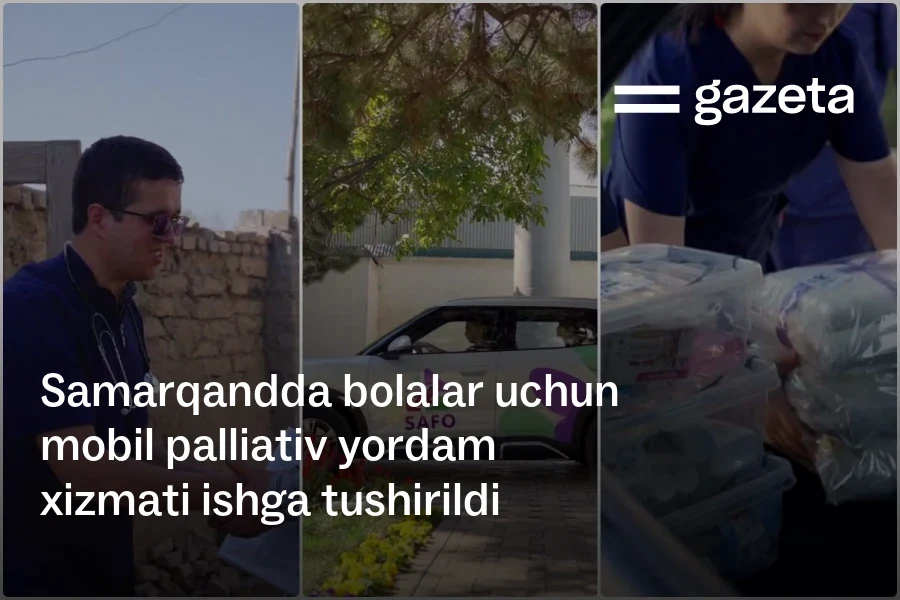
A mobile palliative care service for children with severe and incurable illnesses began operating in Samarkand region starting September 28, as reported by the National Agency of Social Protection.
The team includes medical specialists, social workers and psychologists. Their main tasks are to provide assistance to children at home, alleviate pain and disease symptoms, develop individual support plans for children and their caregivers, and teach parents caregiving skills.
According to the agency, more than 300 children in need of special assistance have been identified in the region.Advertising on Gazeta
The Inson social services center opens an individual case for each child and helps obtain the necessary social services and technical rehabilitation aids, including customized wheelchairs, verticalizers, functional beds and mattresses designed to prevent bedsores.
In the agency's video, one of the staff members said the mobile team visits 8 to 12 households every day.
"In many cases, people lose hope, believing the child is now bedridden and nothing can be changed, and they try to refuse help," she said.
Relatives of children with severe illnesses spoke about the difficulties of caregiving, which requires a lot of time and effort. One of them said he was forced to sell his car to pay for the child's treatment.
"She cannot hear, she cannot see, she cannot sit, she cannot speak — in short, she has problems on all sides. But she is a child like any other. She should also see the world," said one of the mothers.
Shahnoza Mirziyoyeva, first deputy director of the National Agency of Social Protection, emphasized that palliative care does not depend on whether the patient will live a month or a year. "We monitor them every day and provide assistance," she said.
"We cannot change a child's diagnosis, but changing each of their days is in our hands. Our goal is to give families the opportunity to receive care at home or in a hospice, based on the child's needs. For me, this project is connected not only with providing medical care, but also with changing our attitude toward children with incurable illnesses," said Shahnoza Mirziyoyeva, first deputy director of the National Agency of Social Protection.
"An illness may limit a child's abilities, but it should not limit our efforts to ensure they live a full life. I really want our attitude toward such children to change along with the establishment of the children's hospice," she added.
According to the National Agency of Social Protection, construction of a children's hospice in Samarkand region is also continuing in parallel. The plan is to make the mobile service and the hospice part of a unified system for providing palliative care to children and supporting their families.
We remind readers that in June, the Palliative and Hospice Care Association was openedin Tashkent. Its board chairman Yahyo Ziyoyev spoke about plans to launch mobile brigades and to abandon the concept that hospices should only be stationary facilities. According to the specialist, in the future the entire process is planned to be monitored through the E-Palliative electronic platform.
On June 11, plans to create a unified system for providing palliative and hospice care in Uzbekistan starting September 1, based on the integration of medical and social services, were presentedto the president. The plan envisaged the phased establishment of hospice facilities in all regions, with the interregional hospice in Tashkent designated as the institution responsible for methodological management.
A 50-bed hospice for adults was planned to be established in the Qibray district of Tashkent region. It was scheduledto open in 2019, but due to a lack of funding the project was postponed year after year. The facility was expectedto start operating at the end of the first quarter, but later this deadline was moved to July.